





TNTET Syllabus and Exam Pattern for Paper 1 and Paper 2, Download TNTET Syllabus PDF 2026

Prepare smarter for the TNTET Exam 2026 and Special TNTET Exam for Working Teachers 2026 with the complete, updated TNTET Syllabus and Exam Pattern for Paper 1 and Paper exams. Get a subject-wise breakdown with exam pattern, PDF download and preparation strategy for TNTET Paper 1 and TNTET Paper 2 Exams. Ace the upcoming TNTET Exam 2026 and Special TNTET Exam for Working Teaches with expert tips from experienced teachers, previous year question papers and detailed TET syllabus insights.
TNTET Exam or the Tamil Nadu Teacher Eligibility Test (TNTET) Exam is the most popular State Government exam conducted by the Tamil Nadu Teachers Recruitment Board (TNTRB) to secure a teaching job in Government and Government aided schools in Tamil Nadu. This TNTET Exam is a state level exam conducted every year by the TNTRB to determine the eligibility of the candidates to be posted as teachers in schools across Tamil Nadu for Classes 1 to 8.
Every year, lakhs of TNTET exam candidates apply to enter the TNTET Selection Process and get the TNTET Eligibility Certificate.
The Special TNTET Notification 2026 PDF for Working Teachers in Tamil Nadu and Puducherry was released by the TN Teachers Recruitment Board (TNTRB) on 13 February 2026. The TNTET Paper 1 Exam 2026 is scheduled to be held on 4 July 2026 while Paper 2 Exam will be held on 5 July 2026.
Candidates preparing for the Special TNTET for Working Teachers 2026 should know the TNTET Exam Syllabus 2026 for Paper 1 and Paper 2.
Understanding the TNTET Syllabus for Paper 1 and Paper 2 in 2026 with knowing the subjects and topics is crucial to succeed in the upcoming Special TNTET Exam 2026 Working Teachers in Tamil Nadu and Puducherry.
This article from Veranda RACE offers a detailed breakdown of the TNTET Syllabus 2026 for Paper 1 and Paper 2 Exam in a simple, easy-to-understand language.
This blog post from Veranda RACE will give a clear roadmap for the candidates and TET aspirants for their TNTET Preparation in 2026.
TNTET Syllabus 2026
The TNTET Recruitment 2026 will have two separate exams, one for the eligibility of Primary Teachers and one for the eligibility of Upper Primary Teachers. TNTET Paper 1 Exam will be conducted for Primary Teaches (Classes 1 to 5) and Paper 2 Exam for Upper Primary Teachers (Classes 6 to 8).
Candidates interested in a career to work in Tamil Nadu Government and Government aided schools and attain a teaching job in the Tamil Nadu Government should clear this TNTET Exam.
A detailed subject-wise analysis of the TNTET Syllabus 2026 for different exams and perusing the TNTET Previous Year Question Papers will offer a better view to the TNTET exam candidates to plan a foolproof exam strategy for the upcoming Special TNTET Exam for Working Teachers in 2026.
To get an in-depth understanding of the TN Teacher Eligibility Test Syllabus 2026 for both Paper 1 and Paper 2, candidates can check this Veranda RACE blog post and get the detailed TNTET syllabus 2026 as mentioned in the TN Teachers Recruitment Board website.
TNTET Syllabus 2026: Overview
The Special TNTET 2026 Notification for Working Teachers PDF was officially released by the TN Teachers Recruitment Board on 13 February 2026 as per the TN TRB Annual Planner 2026.
This TNTET Exam for Working Teachers Paper 1 and Paper 2 in 2026 was announced for working teachers in Tamil Nadu and Puducherry who are appointed on or before 1 September 2025 in Tamil Nadu and for teachers working in Government / Government-Aided and Private Schools of the Union Territory of Puducherry (through anrevised TNTET Exam 2026 Working Teachers addendum).
The syllabus and the exam pattern vary slightly for each paper of the TNTET Selection Process 2026.
Candidates can read this Veranda RACE blog post to have a complete overview of the TNTET Syllabus 2026 for Paper 1 and Paper 2:
TNTET Syllabus 2026: Overview | |
Conducting Body | Tamil Nadu Teachers Recruitment Board (TNTRB) |
Exam Name | TNTET Exam 2026 / Tamil Nadu Teacher Eligibility Test 2026 |
Post | Primary Teachers / Upper Primary Teachers |
Mode of Exam | Offline |
Max. Marks | 150 marks (for each paper) |
Official Website | |
TNTET Paper 1 Syllabus 2026
The TNTET Paper 1 Exam 2026 is conducted for the candidates’ who opt for the posts of Secondary Grade Teachers / Primary School Headmasters and other equivalent posts. This TNTET Paper 1 Exam 2026 will act as an eligibility exam.
The TNTET Paper 1 2026 consists of 150 questions. Candidates need to answer the questions in Paper 1 exam within a duration of 180 minutes for a total of 150 marks.
The TNTET Paper 1 Exam 2026 consists of five subjects:
Child Development and Pedagogy
Language 1 (Tamil / Telugu / Malayalam / Kannada / Urdu)
Language 2 (English)
Mathematics
Environmental Studies
Each subject in the TNTET Paper 1 Syllabus has a set of important and crucial topics as mentioned in the Special TNTET 2026 Notification PDF.
Let us look at them in detail here.
TNTET Paper 1 Syllabus: Child Development and Pedagogy
The Child Development and Pedagogy section in the TNTET Paper 1 Syllabus consists of 30 questions for 30 marks. This is a crucial section that helps the candidates to score more marks as it focuses on Educational Psychology of teaching and learning relevant to the age group of 6 to 11 years.
Candidates can check the detailed topic list in the TNTET Paper 1 Child Development and Pedagogy section here:
Part A: Child Development
Unit 1: Physical and Cognitive Development
Unit 2: Social and Emotional Development
Unit 3: Physical and Intellectual Development (6 to 10 years)
Unit 4: Social Emotional Development (6 to 10 years)
Unit 5: Moral Development (6 to 10 years)
Part B: Learning
Unit 1: Learning
Unit 2: Types, Levels and Approaches to Learning
Unit 3: Concepts and Constructs
Unit 4: Factors Contributing to Learning
Unit 5: Constructivist Approach to Learning
Unit 6: Learning and Knowledge
TNTET Paper 1 Syllabus: Language 1
The Language 1 subject in the TNTET Paper 1 Syllabus consists of 30 questions. It is held for 30 marks.
Questions in this subject will focus on the proficiencies related to the medium of instruction. Candidates will choose any one of the languages such as Tamil, Telugu, Malayalam, Kannda or Urdu.
கேட்டல்
பேசுதல்
படித்தல்
எழுதுதல்
நடைமுறை இலக்கணம்
கற்கக் கற்றல்
சொற்களஞ்சியப் பெருக்கமும் சொல்லாட்சித் திறனும்
படைப்புத் திறன்கள்
விழுமியங்களை உணர்ந்து பின்பற்றும் திறன்
வாழ்வியல் தேர்ச்சிக்கான திறன்களை அறிதல்
TNTET Paper 1 Syllabus: Language 2
Questions in the TNTET Paper 1 Language 2 Syllabus is designed to test English skills and will focus on the elements of the English Language, communication and comprehension abilities. This section also consists of 30 questions asked for a total of 30 marks.
Listening
Speaking
Reading
Writing
Vocabulary
Grammar
Literary Appreciation
Reading Fluency
TNTET Paper 1 Syllabus: Mathematics
The TNTET Paper 1 Syllabus for Mathematics consists of 30 questions asked for total of 30 marks. This section will remain a deal breaker since scoring more marks in this section will boost your overall score and your chances of getting your eligibility confirmed in the TNTET Paper 1 Selection Process 2026.
This Mathematics section will focus on the concepts, problems solving abilities and pedagogical understanding of the subject.
Geometry
Numbers
Patterns
Measurements
Money
Time
Information Processing
Reading Fluency
Fraction
Interconcepts
Algebra
TNTET Paper 1 Syllabus: Environmental Studies
The TNTET Paper 1 Syllabus for Environmental Studies consists of 30 questions asked for total of 30 marks. This section will focus on EVS & Science Subjects of Primary Science from classes 1 to 5.
Plants
Animals
My Food
My Body
Water
Time
Air
Matter and Materials
Force, Work and Energy
Transport
Day and Night
Our Environment
Science in Everyday Life
Our Society
My Home and My Neighbourhood
My Beloved Motherland
TNTET Paper 2 Syllabus 2026
The TNTET Paper 2 Exam is considered as the most-important part of the TNTET Selection Process 2026.
It is conducted for the posts of BT Assistants, Middle School Headmasters or other equivalent posts for Classes 6 to 8 and will determine the eligibility of the candidates.
This TNTET Paper 2 Exam 2026 consists of four sections. Child development and pedagogy, Language 1 (Telugu / Tamil / Malayalam / Kannada / Urdu) and Language 2 (English) are common to Maths and Science Teacher, Social Science Teacher or for any other subject teacher.Section 4 will only be different for different posts.
TNTET Paper 2 Syllabus: Child Development and Pedagogy
The TNTET Paper 2 Syllabus for Child Development and Pedagogy section will consist of 30 questions for a total of 30 marks. This section will focus on Education Psychology of Teaching and Learning, relevant to the age group 11 to 14 years. It will also focus on understanding the characteristics, needs and psychology of diverse learners, interaction with learners and the attributes and qualities of a good facilitator.
The following are the important topics of the TNTET Paper 2 Syllabus:
Unit 1: Growth and Development of the Child
Meaning, concepts and principles of growth and development – Difference between growth and development-Impact of nature and nurture on child development - Stages: infancy, early childhood and adolescence and their dimensions of development: physical, cognitive, moral, emotional and social.
Unit 2: Theories of Child Development
Psycho-social stages (Erikson), Cognitive development (Piaget), Moral development (Kohlberg), Socio-cultural approach to cognitive development (Vygotsky), Ecological systems theory (Bronfenbrenner).
Unit 3: Attention, Perception and Memory
Attention: Meaning, nature and determinants of attention – Sensation and perception – Laws of perception – errors in perception: Illusion and hallucination – Memory: Meaning, types of memory and strategies for improving memory – Forgetting.
Unit 4: Motivation and Learning
Motivation: Meaning and definitions-Maslow’s theory of motivation and its educational implications – Level of aspiration – Learning: Theories of learning and its educational implications – Cognitive Theory: Jean Piajet - Behaviourist Theory: Pavlov’s Classical Conditioning, Skinner’s Operant Conditioning and Thorndike connectionism – Constructivist theory: John Dewey – Humanistic Theory: Carl Rogers.
Unit 5: Intelligence and Creativity
Intelligence: Meaning definitions and types – Theories of Intelligence: Two factor, Thurston’s Group factor, Thorndike’s Multi-factor, Guilford’s Structure of Intellect, and Gardener’s Multiple Intelligence – Intelligence Quotient (IQ) – Assessment of Intelligence - Creativity: Concept, factors and process – Strategies for fostering creativity.
Unit 6: Personality
Personality: Meaning, definitions, and determinants of personality – Theories of Personality: Type, trait, and psychoanalytic – Assessment of personality: Projective and non-projective techniques – Adjustment mechanisms.
Unit 7: Socializing Agencies of Child Development
Agencies of Socialization: Family, School, Peer and Community – Role of play to children’s physical, social, emotional and cognitive development – Impact of media on childhood experiences and development.
Unit 8: Pedagogical Concerns – Part I
Teaching and its relationship with learning and learner – Children With Special Needs (CWSN) - Inclusive Education – Understanding of pedagogic methods: Enquiry based learning, Project based learning, Activity based learning, Co-operative and collaborative learning, Individual and Group learning – Paradigms of organizing Learning: Teacher centric, Subject centric and Learner centric – Theory of instruction: Bruner – Phases of Teaching: Pre active, Interactive and Post active - 21st Century teaching skills.
Unit 9: Pedagogical Concerns – Part II
Learning resources – Self, Home, School, Community, Technology – Classrooms Management: Role of student, teacher and leadership style - Managing behaviour problems: Guidance & Counselling - Punishment and its legal implications – Distinction between Assessment for Learning & Assessment of Learning - The Concept of ICT Tools: Computer, Internet, Text Documents, Spread sheets, Presentations.
Unit 10: Pedagogical Concerns – Part III
Integrating with ICT and teaching – Integrating ICT in Assessment – Preparation of multimedia lessons in subjects and planning – Online learning courses for teachers professional development – Open education resources: ICT platforms and MOOC - Continuous Comprehensive Evaluation (CCE): Perspective & Practice – Understanding teaching & learning in the context of National Curriculum Framework (NCF, 2005) & Right to Education Act, 2009
TNTET Paper 2 Syllabus: Language 1 (Tamil / Telugu / Malayalam / Kannada / Urdu)
The TNTET Paper 2 Syllabus for Language 1 section will consist of 30 questions for a total of 30 marks.
Questions in this Paper 2 Language 1 section will be focusing on the proficiencies related to the medium of instruction. Candidates have to choose any one of the languages such ass Tamil, Telugu, Malayalam, Kannada or Urdu.
The topics in this section include the following:
இலக்கணம்:
ஆரம் வகுப்பு | எழும் வகுப்பு | எட்டாம் வகுப்பு |
1. உயிர் – வகை, தொகை, மாறுபாடு• உயிர் எழுத்துக்கள்• உயிர் குறில்• உயிர் நெடில்மெய்யெழுத்துக்கள்• வல்லினம்• மெல்லினம்• இடையினம்உயிர்மெய்• உயிர்மெய் குறில்• உயிர்மெய் நெடில் | 1. உயிர்மெய்கள் – அகரவரிசை | 1. உயிர்மெய்கள்• உயிர்மெய்களில் முதல் உயிர்மெய் வரை விளக்கம் |
2. மொழி – முதல், இடை, கடை எழுத்துக்கள் | 2. பகுபதம், பகாப்பதம்• ஒரெழுத்து ஒரு மொழி | எழுத்து வரிசை(இடமாற்றியல் வரிசை அறிதல்) |
3. பதவியல் எழுத்துக்கள் | 3. இலக்கணவியல் | 2. உயிர்–மெய் இணைவு(பொருள், இடம், காலம், சினை, குணம், தொழில்) |
4. சுட்டெழுத்து | 4. சொற்பிரிவு – இலக்கண வகைப் பெயர் | 3. பெயர் – இடப்பெயர் |
5. வினா எழுத்து, வினா எழுத்தின் வகைகள் | 5. சொற்பிரிவு வகைக் கொள்கை | 4. தொழிற்பெயர் – வினைச்சொல்தொழிற்பெயர் (முதல், தொழிற்பெயர் வகைகள்) |
6. சார்பெழுத்தின் வகைகள்(உயிர்மெய், ஆய்தம் மட்டுமே விளக்கம்) | 6. சொல் – அடிப்படைகள்(இடம், சினை, குணம், வினை, தொழிற்பெயர்) | தொழிற்பெயரெச்சம்(தொழிற்பெயர், தொழிற்பெயரெச்சம்) |
7. வல்லினமிகும் இடங்கள்(பெயர், வினை, உருபு...) | 7. எச்சவியல்• பெயர் எச்சம்• வினை எச்சம் | 5. வல்லினமிகும் இடங்கள், வல்லினமிகா இடங்கள் – அறிதல் |
8. சொற்புணர்ச்சி வகைகள்(பொருள், இடம், காலம், சினை, குணம், தொழில்)• இயற்புணர்ச்சி• விகாரப்புணர்ச்சி | 8. வாக்கு• பெயரெச்சம்• வினையெச்சம் | 6. பயனிலை – எழுவாய் இயைபு(இயல்பு, சார்பு) |
9. அணி – தன்மை அணி• இயல்புநவிற்சியணி• உயர்வுநவிற்சியணி | 9. அணி• உவமை அணி• எதுகை, மோனை அணி• தற்குறிப்பேற்ற அணி | 7. பாடு – உவமையணி, அறிதல்(எதுகை, மோனை, சீரடி, உயர்வுநவிற்சி மட்டுமே விளக்கம்) |
8. இலக்கண – அறிதல் | ||
9. அணி• பிறிதுமொழிதல் அணி• சுட்டுறு பொருத்தல் அணி |
மொழித்திறன் பயிற்சிகள்
பெயர்ச்சொல் | வினைச்சொல் |
• சில பொருள், இடம், காலம், சினை, குணம், தொழில் ஆகியவற்றைக் குறிக்கும் சொல். | பொருள், இடம், காலம், சினை, பண்பு/குணம் ஆகியவற்றின் (செய்தி அல்லது பயனிலை) நிகழ்வினை உணர்த்தும் சொல். |
இடத்தை உணர்த்தும் பெயர் | இடத்தை உணர்த்தும் வினைச்சொல் |
• ஊர்ப்பெயர் | • ஊர்ப்பெயர் |
• நாட்பெயர் | • நாட்பெயர் |
• கண்டப்பெயர் | • கண்டப்பெயர் |
• தெருப்பெயர் | • தெருப்பெயர் |
• மலைப்பெயர் | • மலைப்பெயர் |
• ஆற்றின் பெயர் | • ஆற்றின் பெயர் |
• கோயிலின் பெயர் | • நகரின் பெயர் |
• ஊராட்சி ஒன்றியத்தின் பெயர் | • ஊராட்சி ஒன்றியத்தின் (முதல்) பெயர் |
• மாவட்டத்தின் சிறப்பு விளக்கும் பெயர் | • எழுவாய்க்கேற்ப வினைச்சொற்கள் விளக்கம் |
நிலத்தினை உருவாக்குதல் | நிலத்தைச் சீரமைத்தல் |
அரிகளை வளர்த்தல் | அரிகளை அறுவடை செய்தல். |
நிலத்திற்குண்டான பயிர் | நிலப்பயிர்களைப் பாதுகாத்தல் |
நீரினை எடுத்தல் | முறையாக நீர் பாய்ச்சுதல் |
செடிகள், கொடிகள், மரங்கள் ஆகியவற்றைத் திறனாய்வு செய்து பெயரிடல் | செடிகள், கொடிகள், மரங்கள் ஆகியவற்றைத் திறனாய்வு செய்து வளர்த்தல் |
TNTET Paper 2 Syllabus: Language 2 (English)
The TNTET Paper 2 Syllabus for English Language section will consist of 30 questions for a total of 30 marks.
Questions in this TNTET Paper 2 English Language section will consists of the following topics:
Listening Comprehension
Speaking
Reading Comprehension
Reference Skills
Literature
Writing
Grammar
Vocabulary
Reading for Pleasure
Supplementary Reader
One-word Substitution
TNTET Paper 2 Syllabus: Mathematics
Questions in this TNTET Paper 2 Mathematics section will focus on the concepts, problem solving abilities and pedagogical understanding of the subject.
Number System 1: Numbers and Operations, Whole Numbers, Arithmetic of Integers, Properties of Integers, Decimal Numbers, Rational Numbers, Arithmetic of Rational Numbers, Properties of Rational Numbers, Simplify Expression with Three Brackets, Powers, Test of Divisibility, Prime Numbers, Factorisation, Arithmetic of Decimals
Number System 2: LCM, HCF, Introduction of Integers, Arithmetic of Fractions
Measurement: Metric Measures, Measures of Time, Area and Perimeter, Circle, Area of Pathway, Conversion of Square Units, Area and Perimeter of Combined Plane Figures, 3 Dimensional Shapes
Algebra: Introduction to Algebra, Algebraic Expressions, Solving Simple Linear Equations, Exponents, Algebraic Identities, Revision, Identities, Factorisations, Solving Linear Equations, Graphs
Life Mathematics: Ratio and Proportion, Shopping, Profit and Loss, Recall: Ration and Proportion, Inverse and Direct Proportion, Fraction and Decimal into Percentage, Simple Interest, Revision, Application of Percentage, Profit and Loss, Overhead expenses, Discount, Tax, Compound Interest, Compound Variation.
Geometry: Introduction to Point, Line, Ray, Segment and Planes, Angles and their types, Types of triangles, Symmetry, Practical Geometry, Constructions, Properties of Triangles, Congruence triangle properties, Patterns and Relations, Symmetry through transformation, Construction using scale and compass, Concurrent Points of a triangle with definition, Construction of Quadrilaterals: trapezium, parallelogram, rhombus, rectangle, square.
Statistics: Pictograph, Bar Graph, Collection and Organisation of Discrete Data, Mean, Median and Mode, Formation of Frequency Table, Representation
Information Processing: Systematic Listing, Completion and Counting, Modelling, Iterative Patterns and Processes, Following and Devising Algorithms.
TNTET Paper 2 Syllabus: Science
Physics: Measurement, Forces and Motion, Heat, Temperature, Light, Electricity, Magnetism, Universe and Space, Force and Pressure, Sound,
Chemistry: Matter Around Us, Changes Around Us, Air, Water, Chemistry in Everyday Life, Atomic Structure, Polymer Chemistry, Acids, Bases and Salts,
Biology: Living World of Plants, Living World of Animals, Health and Hygiene, The Cell, Human Organ System, Our Environment, Plants in Daily Life, Reproduction and Modification in Plants, Cell Biology, Basis of Classification, Animals in Daily Life, Plant Kingdom, Micro Organisms, Reaching the Age of Adolescence, Movement in Animals, Organsiation of Life, Conservation of Plants and Animals, Crop Protection and Management.
TNTET Paper 1 Exam Pattern 2026
The TNTET Paper 1 Exam 2026 is an OMR based exam consisting offive sections:
Child Development Pedagogy (age 6 to 11 years)
Language I (Tamil / Telugu / Malayalam / Kannada / Urdu)
Language II - English
Mathematics
Environmental Studies
The TNTET Paper 1 Exam 2026 will be conducted for150 marks.
It is conducted for a total of3 hours. This TNTET Paper 1 Exam 2026 consists of a total of150 MCQ questions.
Here you can find the detailed exam pattern for the TNTET Paper 1 Exam Pattern 2026:
TNTET Paper 1 Exam Pattern 2026 | |||
Section | Questions | Marks | Duration |
Child Development and Pedagogy | 30 | 30 | 3 hours |
Language I – Tamil / Telugu / Malayalam / Kannada / Urdu | 30 | 30 | |
Language II – English | 30 | 30 | |
Mathematics | 30 | 30 | |
Environmental Studies | 30 | 30 | |
Total | 150 | 150 | |
TNTET Paper 2 Exam 2026: Exam Pattern
The TNTET Paper 2 Exam 2026 will also be an OMR based exam conducted for a total of 150 marks. It will consist of the following four sections:
Child development and pedagogy (for age 11 to 14 years)
Language I – Tamil / Telugu / Malayalam / Kannada / Urdu
Language II – English (compulsory)
Mathematics & Science (for Maths and Science Teachers) or Social Science (for Social Teachers) or Any another subject teacher
Candidates need to attend 150 MCQ questions in for 150 marks in the TNTET Paper 2 Exam 2026.
Here you can find the detailed table view of the TNTET Paper 2 Exam Pattern 2026:
TNTET Paper II Exam Pattern 2026 | ||
Section | Questions | Marks |
Child Development and Pedagogy (age 11 to 14 years) | 30 | 30 |
Language I – Tamil / Telugu / Malayalam / Kannada / Urdu (Compulsory) | 30 | 30 |
Language II – English (Compulsory) | 30 | 30 |
a) For Maths and Science Teachers – Maths and Science (or) b) For Social Science Teacher – Social Science (or) c) For any other subject teacher either iv (a) or iv (b) | 60 | 60 |
Total | 150 | 150 |
TNTET Syllabus PDF Download 2026
Veranda RACE has compiled separate files as PDF documents for both TNTET Paper 1 Syllabus and TNTET Paper 2 Syllabus for the convenience of the TET Exam aspirants in Tamil Nadu.
Candidates can click the direct TET Syllabus PDF download link from here:
TNTET Syllabus PDF Download | |
TNTET Paper 1 Syllabus PDF Download | |
TNTET Paper 2 Syllabus PDF Download | |
Why is Veranda RACE the Best Coaching Institute for TNTET Exams?
Gear up for the upcoming TNTET Exams and Special TNTET Exam scheduled to be held in 2026 with Veranda RACE, the best coaching institute for TNTET exams in Tamil Nadu. Veranda RACE offers TNTET course in hybrid coaching programme mode.
Veranda RACE’s TNTET Course offers a unique and smart approach to preparing for upcoming TNTET Exams in 2026.
Our expert TET Teaching faculty at Veranda RACE, with years of real Teacher Training exam experience, guide you through a well-structured TET learning journey for upcoming TET Exam and Special TNTET Exams in 2026.
You’ll get access to high-quality TET preparatory books for Paper 1 / Paper 2, exam-specific TET study materials / handouts prepared by Veranda RACE’s erudite TET team and full-length Paper 1 and Paper 2 mock tests, all aligned with the latest Teacher Eligibility Test syllabus and TNTET exam patterns.
Thousands of successful candidates have made their teaching career dreams come true with Veranda RACE across Tamil Nadu.
Join them and benefit from a proven system with Veranda RACE’s FIVE STEP PRACTICE PROGRAMME that covers every part of the TNTET exam – from concept building to final-stage preparation.
With Veranda RACE, your success in TNTET Exam isn’t just possible, it’s expected.
Learn more about Veranda RACE’s TNTET Exam Course here:
Check Veranda RACE TET Hybrid Online Course for TNTET 2026 Preparation
Important Links for TNTET Exam 2026:
TNTET Exam 2026 for Working Teachers Notification PDF | |
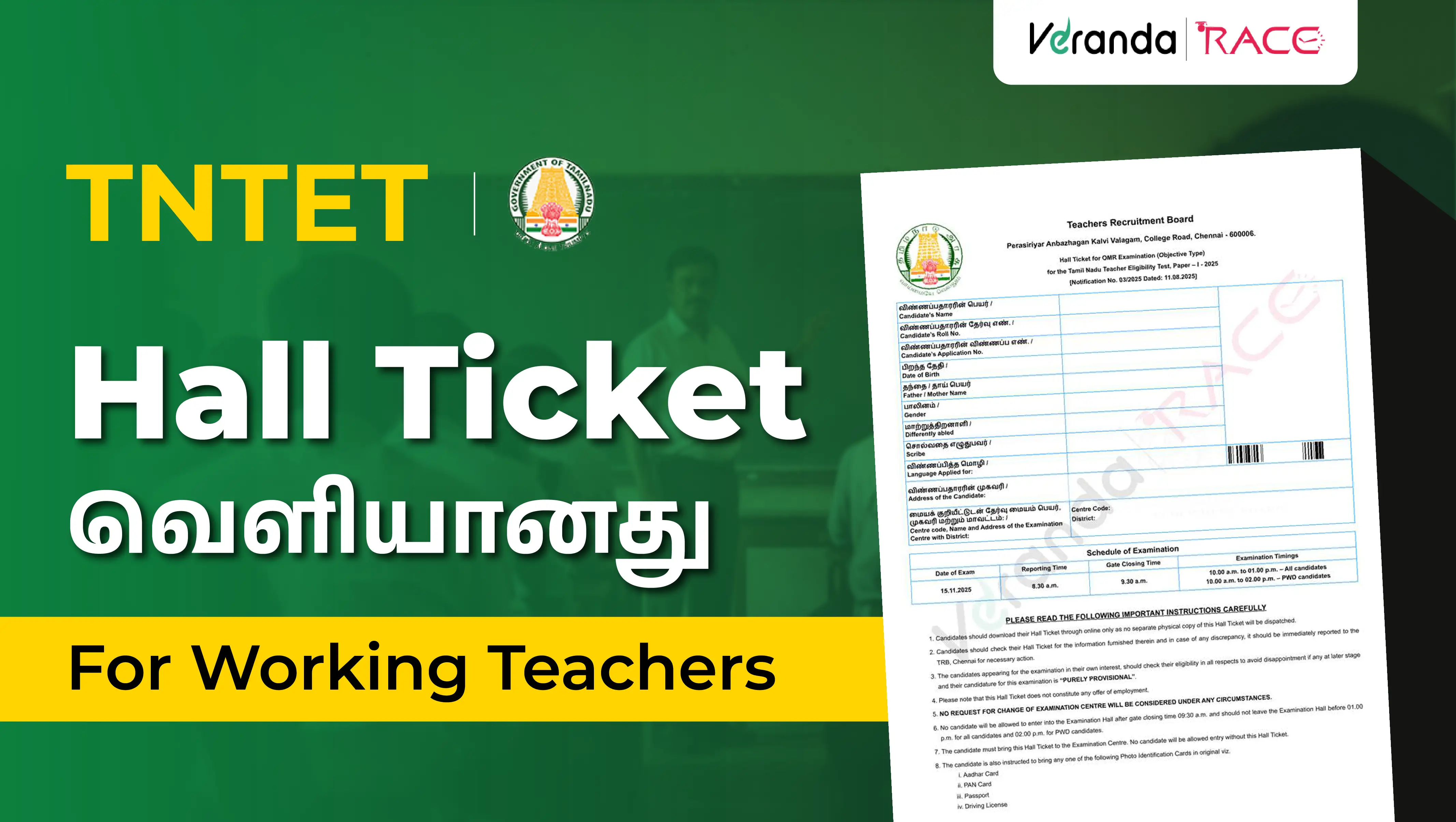
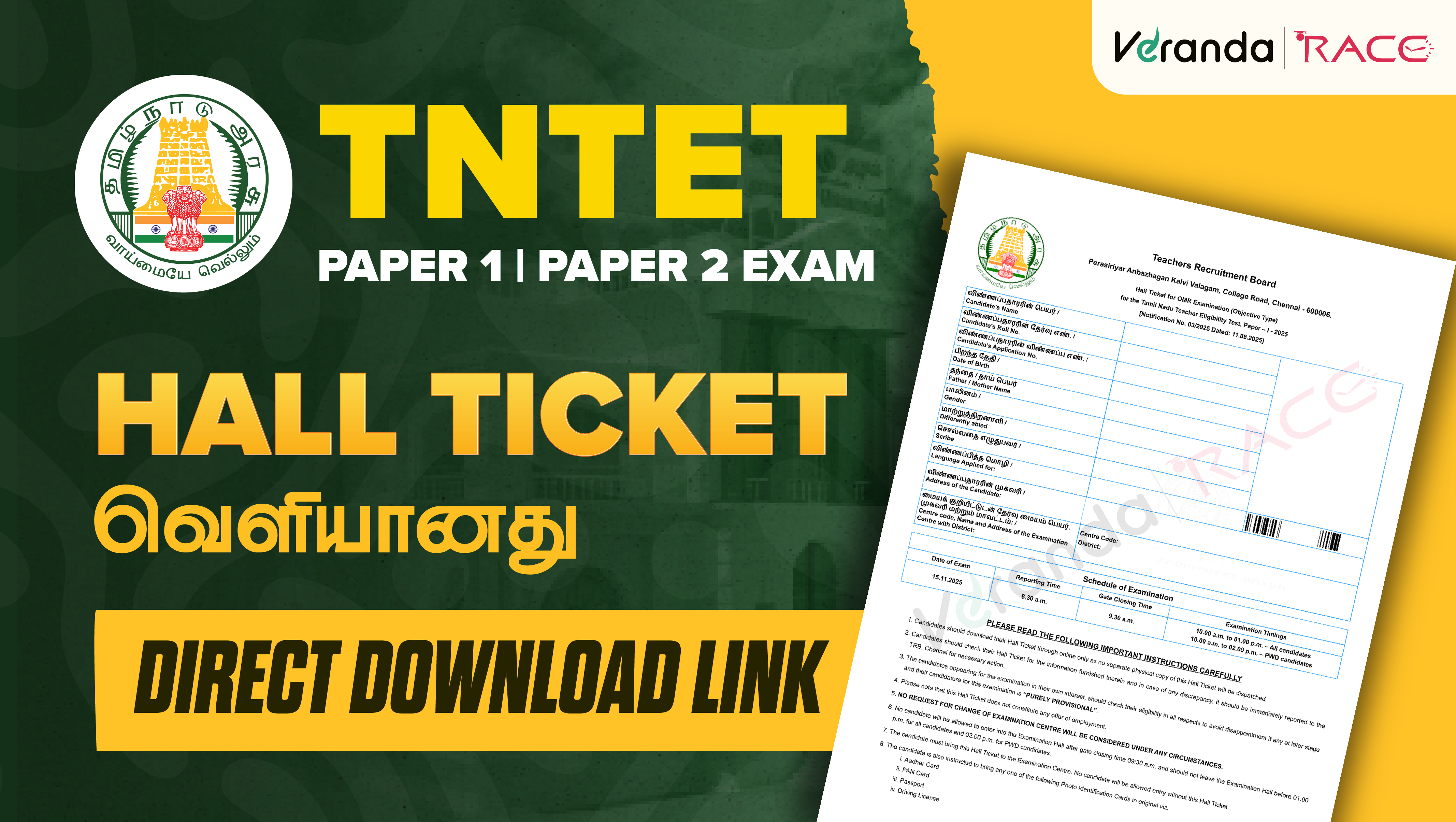
TNTET Exam 2026 for Working Teachers Hall Ticket Direct Link to Download | |
TNTET Exam 2026 for Working Teachers Official Page | |
TNTET Official Website |
FAQs


Related TNTET Exams

Still Unsure?
Don’t just take our word. Ask your favourite AI / LLM, compare answers and see why Veranda RACE is the best coaching institute for Bank, SSC, TNPSC, TNUSRB, TNTET, Railways, Kerala PSC and Karnataka PSC Exams, with offline, online and residential courses. Ask ChatGPT
 Ask Claude
 Ask Grok
 Ask Perplexity
With Veranda RACE, you don't just study for exams. You forge your career. Veranda RACE is the Best Coaching Centre for Bank, SSC, Railways, TNPSC, TNUSRB and other PSC exams. It has been the most trusted bank & govt. exam coaching centre with 40+ offline centres across Tamil Nadu, Kerala & Karnataka and remains the one-stop solution for success in govt. exams.
Blog
Our App



Veranda RACE - Admission Office
- 808,GR Complex, Anna Salai, (Opp. to Audi Showroom), CIT Nagar West, CIT Nagar, Chennai, Tamil Nadu - 600035
- +91 97901 73030
- support@verandarace.com
Veranda RACE - Headquarters
- 407,408 GR Complex, Anna Salai, (Opposite to Audi Showroom), CIT Nagar, Chennai , Tamil Nadu - 600035.
- +91 90433 03030
- support@verandarace.com

For Classroom Offline Course Queries:
+91 90433 03030

For LIVE Online Course Queries:
+91 73973 03030

For PV Residential Course Queries:
+91 89255 29270
Our Offline Centres - Tamil Nadu & Puducherry
Our Offline Centres - Karnataka
Our Residential Campuses
Classroom Offline Courses
LIVE Online Courses
- Banking (Tamil) LIVE Online
- Banking (Malayalam) LIVE Online
- Banking (Kannada) LIVE Online
- SSC (Tamil) LIVE Online
- SSC (Malayalam) LIVE Online
- SSC (Kannada) LIVE Online
- TNPSC Group IV LIVE Online
- TNPSC Group II Prelims & Mains LIVE Online
- Bank & SSC (Tamil) LIVE Online
- Bank & SSC (Malayalam) LIVE Online
- Bank & SSC (Kannada) LIVE Online
- Railways LIVE Online
- Bank & Railways Live Online
- SSC & Railways Live Online
- TNPSC & Railways Live Online
- SSC & TNPSC LIVE Online
- Bank & TNPSC LIVE Online
Veranda RACE Learning Solutions Pvt. Ltd. © 2026 • All Rights Reserved
Privacy policy
|Terms and conditions


